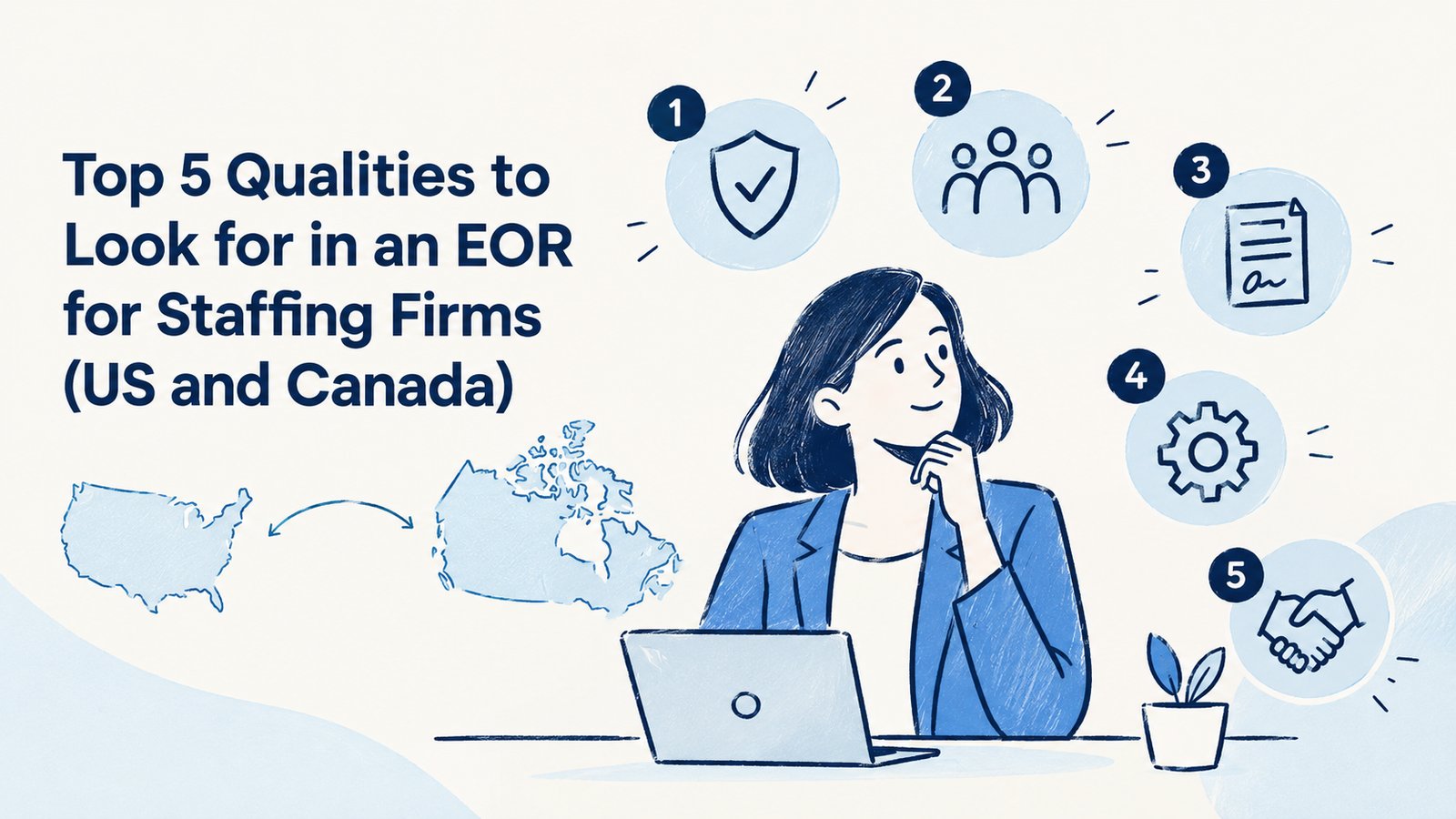
Choosing an employer of record is one of the highest-leverage decisions a staffing firm makes when entering the US or Canada. Get it right and your back office becomes invisible, which is exactly what it should be. Get it wrong, and you inherit compliance exposure, frustrated contractors, and recruiters who keep hearing no.
The five qualities to look for in an EOR as a staffing firm are recruiting speciality; breadth and flexibility of service; a legally informed, business-reasonable approach; service experience; and a tech- and automation-forward platform. Those five separate a genuine EOR partner from a platform with a good website. This guide walks through each one, plus the table stakes worth checking before you get that far.
__________________________________________________________________________________________________________
Table of Contents
Table Stakes: The Floor, Not the Bar
Quality 1: Recruiting Speciality
Quality 2: Breadth and Flexibility of Service
Quality 3: Legally Informed and Business Reasonable
Quality 5: Tech & Automation Forward
Choosing the Right EOR Partner
__________________________________________________________________________________________________________
Three Things Before You Shortlist
1. Competitive Pricing. Get two or three quotes and shop around. Price variation isn’t huge in this market, but you should still check.
One caveat, and it is a real one. If the price is unusually low, ask why. It costs money to do this properly. We have had clients come to us after starting with a low-cost provider and going through several EORs and some brutal experiences. We are slightly more expensive, though not by much. Those clients have told us plainly they were happy to pay it. They needed better service, and they needed their contractors to be happy.
2. Basic compliance and functionality. Don’t assume this one is covered. You will find providers with a slick website who are running their back office on a spreadsheet and a stack of Zapier automations. Ask what the software actually does before you assume it does anything.
3. Software your team can use. If your recruiters and your back office are going to be in it every week, usability is not a nice-to-have.
Now, the five that matter.
Look for an EOR built for staffing, not for global hiring. Most of what comes up when you search "employer of record" is built for companies hiring salaried employees in other countries. That is a different set of problems from a recruitment firm starting up and scaling contract placements in the US and Canada, and the gap tends to show up later as an administrative mess in your back office.
Two quick checks. First, ask whether the provider holds its own entity in each country or subcontracts to whoever does. Many global EORs work through local partners, and every extra link in that chain is one more your contractors and your team have to communicate through. Second, ask how many of their clients are staffing firms. Then get specific: How do they handle timesheets? Who answers worker classification questions, and how quickly? Is the platform built for hourly staffing labor, or was it designed for salaried employees and adapted later? If staffing firms are a small slice of their book, that tells you whose workflow the platform was built around.
As a growing staffing firm, your EOR and back-office needs will change with your size, growth stage, cash position, and risk tolerance. That isn’t a problem. It’s the normal arc of building a staffing business.
So before you evaluate any EOR partner, look at the breadth and flexibility of their service relative to your needs today and where you’re headed. A UK staffing firm entering the US without an entity needs something very different from an established firm that already has a US entity and is running 200-plus contractors. Over a few years of growth, plenty of firms move from the first situation to the second. Your EOR should be able to move with you.
Questions to ask yourself:
- What do I need most from an EOR partner right now?
- What additional needs do I expect over the next couple of years?
Questions to ask the EOR (based on your answers above):
-
Do you provide both EOR and AOR services?
-
Do I need a US entity to work with you?
-
Who handles timesheets, and which system do you use?
-
Who handles client invoicing?
-
Do you provide payroll funding? If so, is it recourse or non-recourse?
-
If my model changes, for example, if I set up my own US entity, can I stay with you, or will I need to switch providers?
That last question deserves the most weight. Changing back-office providers mid-growth disrupts your team, your contractors, and your clients all at once. The right partner is one you won’t outgrow.
A great EOR for staffing firms manages a healthy tension between compliance and getting deals done. Plenty of providers are strong on one and weak on the other. The sweet spot is where the two overlap, and you need both.
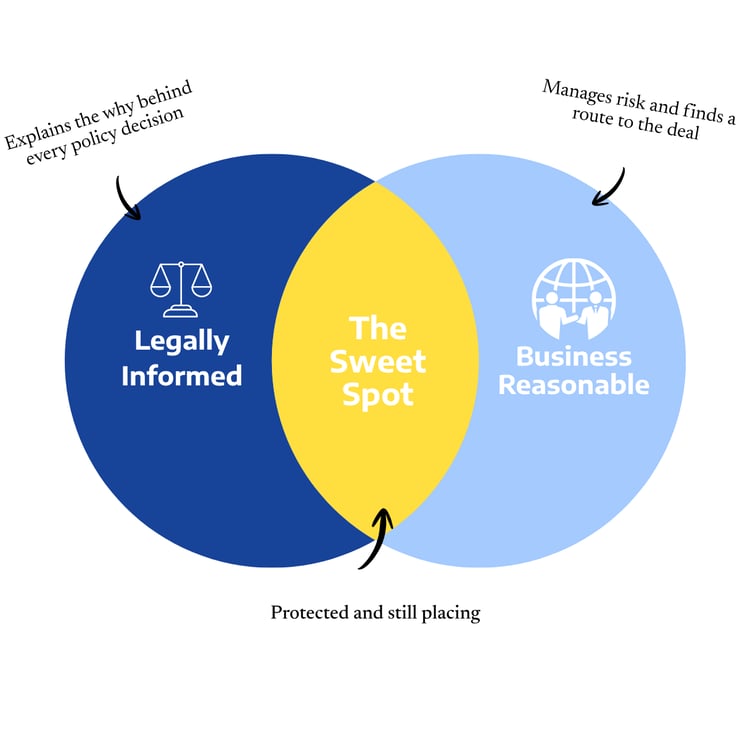
Legally informed means your EOR’s team are experts in their field. They know employment law, they know where the real risk sits, and they use that knowledge to manage it properly while still getting your deals done. You have to have that. Without it, you end up with compliance exposure you didn’t see coming.
Business reasonable means they understand that business is not about eliminating risk. It is about managing it. Risk is notoriously difficult to quantify, and in our world, classification and workers’ compensation calls are exactly the kind of decisions where the answer is not black and white. A good partner makes a judgment. And when they tell you no, they tell you why, and they try to find you a route to the deal. Otherwise, your recruiters keep hearing no, they get frustrated, and they can’t generate revenue for you.
How do you tell, during a sales process, whether a provider is both? They will not tell you they lean one way, and they may not even be self-aware about it. So look at ownership. The larger the provider, and particularly if it has been acquired by a large global workforce group, the more policy-driven it tends to become. Stricter and often unreasonable legal teams arrive, compliance tightens, and the answer starts to be “that is just our policy.” That does not automatically make them the wrong shop. It tells you which way they are heading, and it usually means more platform and less person you can actually talk to.
It also helps to ask around. Ask the provider’s other clients how the EOR handles sticky or unique situations.
1. Get backdoor references. Talk to their clients, and not just the ones on the reference list. We often hear from referrals who, before they ever researched us online, simply asked people in their network which EORs provide the best service. That is a smart way to run the process.
2. Ask how they handle the difficult contractor. You will have unreasonable contractors. It happens. When one of them is frustrated and calling your team or the EOR, how does that EOR respond? Are their reps asking whether the policy even applies to this contractor’s situation, and how to explain it with some tact? Or are they dropping the person into a queue?
3. Treat this as a commercial issue, not a soft one. If your contractors are not happy, your life gets harder, and your attrition costs you money.
Whatever technology an EOR runs on, it is a service business first. The platform matters, but what you will actually feel day to day is how people respond when something goes sideways. Horst Schulze at Ritz-Carlton put it as “ladies and gentlemen serving ladies and gentlemen.” Everyone in this industry is in a people business, whether that is us, you, or another good provider.
1. Look for continued investment. Any EOR worth working with is putting money into its technology on an ongoing basis, and that now includes AI, handled carefully while the security questions are still being worked out.
2. Check API connectivity and availability. Not whether it exists on a slide. Whether it works.
3. Ask whether they adapt to you, or you adapt to them. This is the part worth pausing on. Timesheets are the obvious test. If you already run a global timesheet portal, will your EOR work with it, or require you to use theirs in their geography alongside the nine other systems you are already running? If you operate across multiple countries, you should not have to learn ten systems. Start with yours and find partners who work around it.
The most successful staffing firms focus on the two things that generate gross profit: finding clients and making placements. The challenge is that the legal, administrative, and financial demands of operating in the US can be staggering, especially for firms that are growing quickly or entering the market for the first time. That’s why choosing a great EOR partner has been a savvy, profitable decision for some of the fastest-growing staffing firms in the US.
In this guide, we covered the five qualities to look for in an EOR partner:
- Recruiting specialty: an EOR built for staffing firms and hourly contract labor, not for global hiring of salaried employees.
- Breadth and flexibility of service: a model that fits where you are today and can adapt as your size, cash position, and risk tolerance change.
- Legally informed and business reasonable: real expertise in employment law and risk, used to get deals done rather than block them.
- Service experience: how the EOR treats your contractors, especially the difficult ones, because unhappy contractors cost you money.
- Tech and automation forward: ongoing investment in technology and connectivity that actually works, from a partner that adapts to your systems instead of making you adapt to theirs.
Bring these questions to every provider you talk to, including us.
About Agile Partnering
Agile Partnering is an Inc. 5000 back-office, Employer of Record, and funding partner built specifically for staffing firms in the US and Canada. We take care of the compliance, payroll, and back office so your team can stay focused on clients and placements. If you’re weighing your options, get in touch. We’ll give you clear, honest answers, including if we’re not the right fit.
This content does not constitute legal advice or create an attorney-client or other fiduciary relationship. Please contact your own attorney for legal advice. Links to third-party sites are provided for convenience only, and Agile Partnering is not responsible for their content. For more detail, see here: https://www.agilepartnering.com/privacy-policy#disclaimer.